Blog

SnapInsight prioritises your organisation’s approved content when answering questions. When public web search is enabled and additional information is needed, it uses Tavily to find relevant supporting evidence. In Tavily’s August 2026 evaluation, its search results achieved the highest accuracy across SealQA-Hard, SealQA-0 and SimpleQA Verified.
Most people who use SnapInsight will never wonder which search technology sits behind their answer.
We wonder about it constantly.
Every answer the platform gives goes out under your brand, and it carries your reputation with it. Your community ask a question, your knowledge base responds, and the quality of that moment reflects on you. That's a responsibility we take seriously, right down to components most people will never know exist.
How does SnapInsight decide where an answer comes from?
SnapInsight always answers first from your approved content. Your policies, your standards, your guidance, the material you've reviewed and stand behind. That's the foundation.
But some questions benefit from public information. A recent regulatory update. Context from an industry body. A definition your documents assume but never spell out.
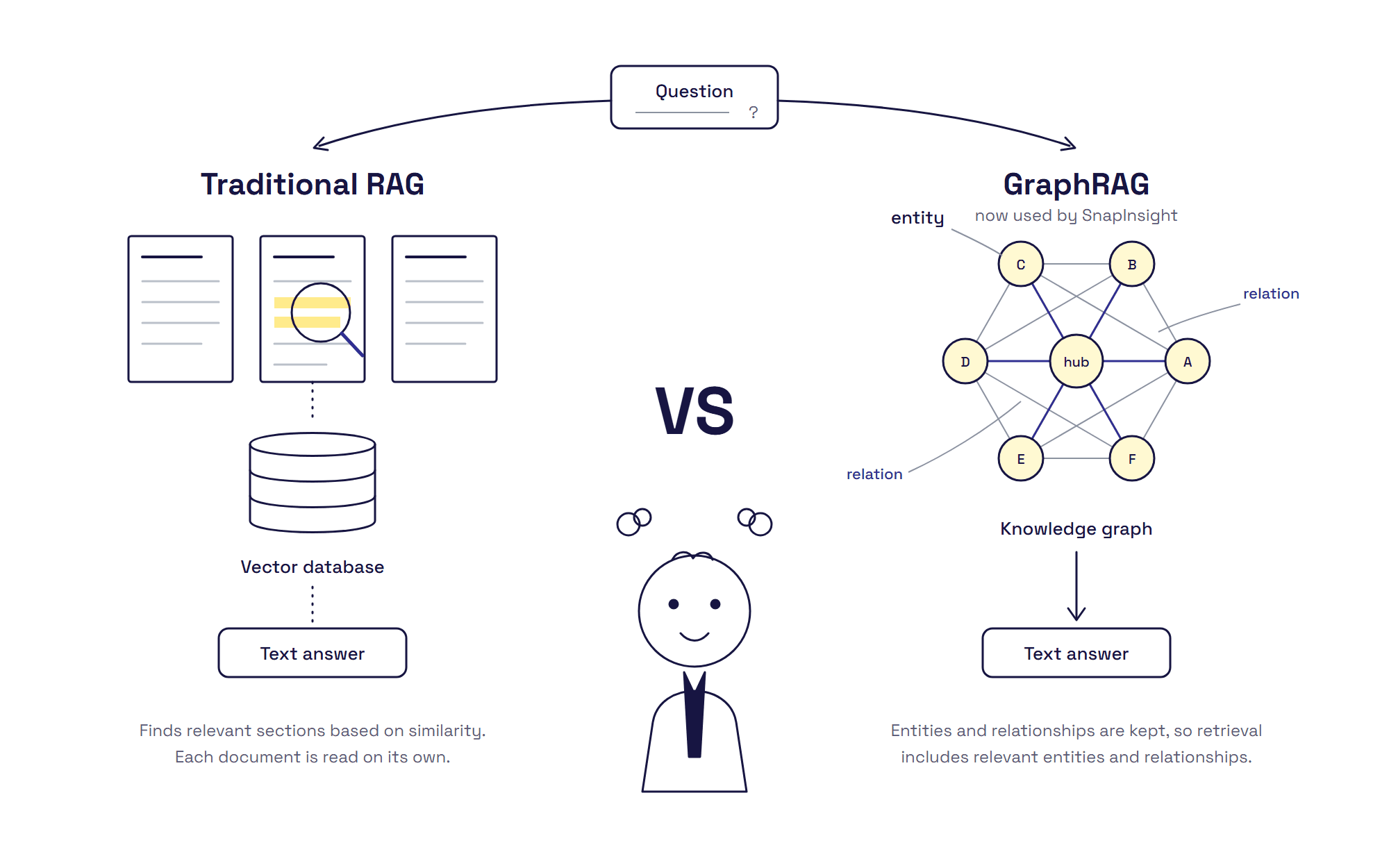
When that happens, and when you've chosen to allow it, SnapInsight sends that job to a dedicated search component. The component gathers evidence from the public web, and the rest of the pipeline decides what deserves a place in the answer.
Most people never stop to ask: how good is that component, really?
What is Tavily?
Tavily is a search technology designed to provide AI systems with relevant web sources and supporting evidence. SnapInsight uses it when an organisation has enabled web search and a question would benefit from current public information.
How was Tavily’s search quality evaluated?
In August 2026, Tavily published the results of its evaluation across three search benchmarks, tested against the other major players in this space, including Perplexity, Exa, Brave, Parallel and You.com. Every variable was held constant except the retrieved results, so the benchmarks isolate one thing: which technology finds the strongest evidence.
The results:
SealQA-Hard - first place, at 55.7% accuracy. Difficult fact-seeking questions involving conflicting or noisy web evidence.
SealQA-0 - first place, at 49.5% accuracy. Challenging factual questions that expose underlying search quality.
SimpleQA Verified - first place, at 97.6% accuracy. Straightforward factual questions where precision is everything.
In this evaluation, Tavily’s results produced the highest answer accuracy across all three benchmarks.
Source: Tavily’s August 2026 evaluation. The same reader model, grader model, prompts and retrieval budget were used across the search providers tested.
Why conflicting sources are the real test
The SimpleQA number is impressive, but the SealQA results are the ones we care about most.
On the public web, the hard part isn't finding information. It's that too much information exists, and much of it disagrees. An outdated page sits next to a current one. A vendor's claim sits next to a regulator's guidance. A confident blog post sits next to the actual standard.
A weak search component treats all of that as roughly equivalent and passes the mess downstream, hoping the model sorts it out. Sometimes it does. Often it doesn't.
Tavily says its search system considers source authority, credibility, relevance and evidence quality. It has also been developed to reduce duplicated or conflicting evidence and improve freshness for time-sensitive topics. That is what the SealQA benchmarks are designed to test, and where Tavily led in this evaluation.
For a brand whose users ask about regulations, standards and compliance, that difference isn't academic. It's the difference between an answer you'd happily put your logo on and one you wouldn't.
What does better search mean for your organisation?
Your users experience a good answer. Behind that answer sits a pipeline of components: ingestion, chunking, embedding, retrieval, ranking, generation, and in some instances, public search.
Each component is evaluated carefully, compared with the available alternatives and reviewed again as the evidence changes. SnapInsight isn't a tool knocked together in the back of a garage. Whether anyone ever looks under the hood, it's built with integrity, because your brand is riding on it.
For a brand whose users ask about regulations, standards and compliance, that difference isn't academic. It's the difference between an answer you'd happily put your logo on and one you wouldn't.
If you'd like to see how SnapInsight combines your approved content with carefully governed public search, get in touch. We're always happy to show you what's under the hood. Book a demo here.
Latest