Blog
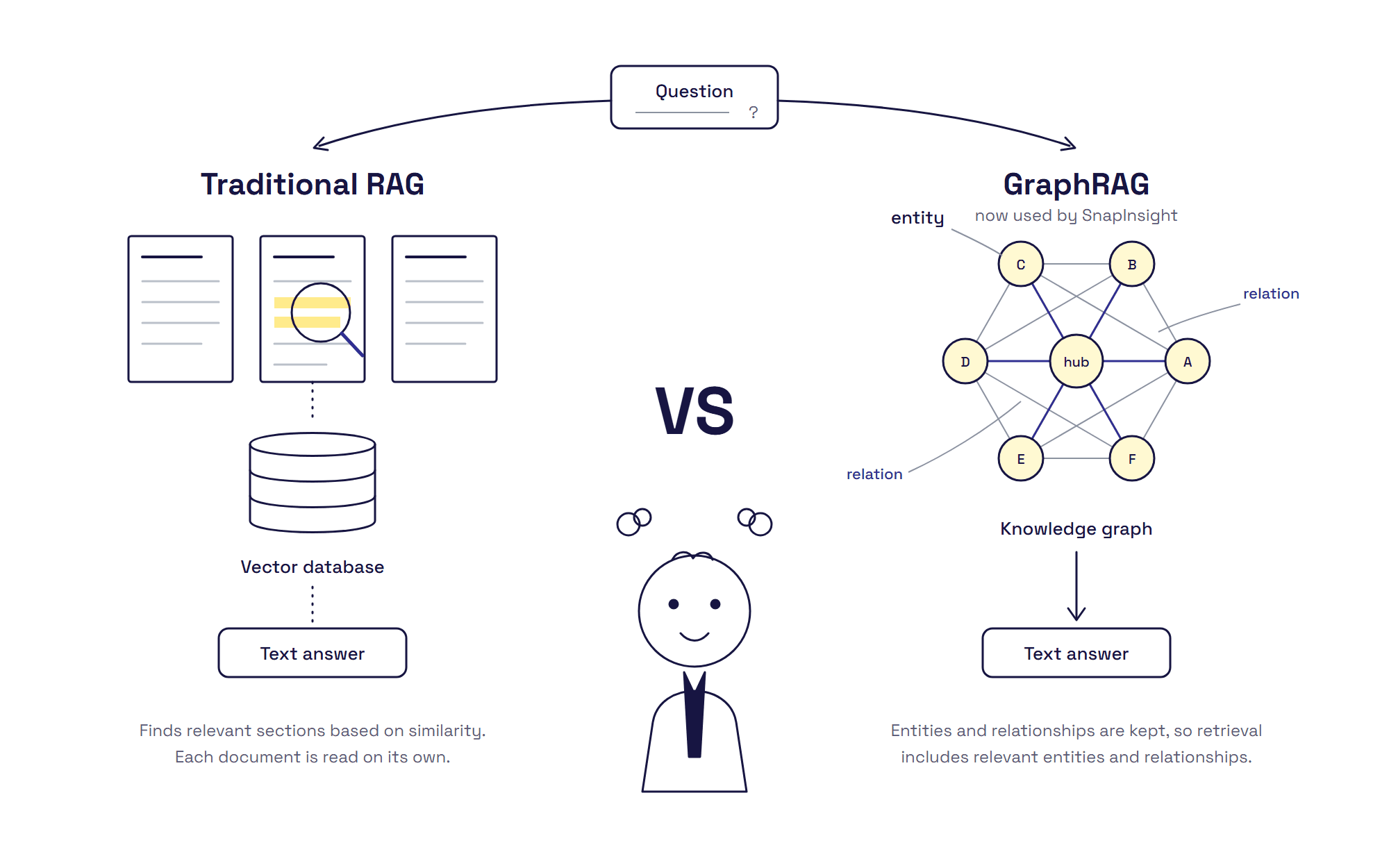
SnapInsight has moved from Retrieval Augmented Generation, or RAG, to GraphRAG. RAG finds relevant sections of documents and uses them to generate an answer. GraphRAG adds a knowledge graph: a map of the people, policies, obligations, concepts and relationships within those documents. This helps SnapInsight identify relevant connections across multiple sources and provide more complete answers to complex questions.
If those terms are new to you, you are in the right place. The way people use SnapInsight has not changed. What has changed is how the platform finds and connects the information needed to answer a question.
How does RAG work?
SnapInsight has been built on a technology called Retrieval Augmented Generation (RAG). The idea is simple. A user asks a question, the system searches the knowledge base for the sections that most closely match the question, reads that paragraph, and writes an answer from what it finds.
Think of it as a capable new starter. You ask a question; they search the shared drive and come back with the three most relevant documents. For direct questions, this works well. If you ask what the minimum safe approach distance is for working near overhead powerlines, the answer sits in one place, the new starter finds that document, and you get a clear, accurate response in seconds.
Where traditional RAG can miss important context
Traditional vector-based RAG retrieves sections of text based largely on their similarity to the question. It finds the closest matching text or semantic meaning, but it may miss important connections when related information sits in another document or uses different language. And the questions that matter in a workplace, especially in highly complex industries, are rarely answered in single paragraphs or single sections.
Concepts are often connected and are relevant, even if there are no keywords or closely sounding wording in that section. Just like as humans – we know things are connected, but not the association is often a lot more complex.
Take an HR manager who asks: an employee has missed three deadlines this quarter. What is the right way to begin performance management? The full answer lives in several places at once. The performance management policy sets out the steps. The enterprise agreement adds a consultation requirement for that employee's classification. A separate procedure covers how meetings must be documented. Each document is accurate on its own, but the right answer depends on how they fit together.
A traditional RAG system may prioritise the policy steps because they most closely match the wording of the question, because that text matches the question best. And the steps themselves are right. The risk is the relevant information the retrieval process may not surface. The enterprise agreement is a separate document, written in different language, so it does not come up in the search, even though it is connected and needs to be taken into consideration. The manager gets the standard process with no hint that an extra consultation step applies to this employee. The answer is not wrong, it is just incomplete, and there is no way to tell that from reading it.
How does GraphRAG differ?
GraphRAG adds a knowledge graph underneath the search. Instead of treating your knowledge base as a pile of separate documents, it builds a map of the things inside them, the policies, roles, obligations and timeframes, and records how they connect. The performance management policy links to the enterprise agreement. The enterprise agreement links to the consultation requirement. The consultation requirement links to the documentation procedure.
When a question comes in, SnapInsight still finds the most relevant material. But now it also follows the connections. It is the colleague who has been there twenty years and knows, without being asked, that the policy you are holding is affected by an agreement saved in a different folder. Or, for the science-minded, it works like the neural connections in your brain, the links between cells that let them share messages.
For that HR manager, the answer can now bring together the policy steps, flags the consultation requirement, and points to the documentation procedure, with every source cited. One question, one fuller answer, and fewer follow-up questions.
RAG vs GraphRAG: the key differences
Traditional RAG | GraphRag | |
|---|---|---|
How it retrieves information | Finds text sections that | Uses text retrieval alongside mapped entities and relationships |
What it does well | Answers focused questions where the information is clearly stated | Handles questions that depend on connections across several sources |
Potential limitation | May miss related information expressed differently or stored elsewhere | Requires the knowledge graph and retrieval process to identify the relevant relationships |
User experience in SnapInsight | Ask a question and review | The same experience, with broader context for complex questions |
What this means for SnapInsight users
Users can ask questions in the same way and still see the sources used to support each answer. What changes is SnapInsight’s ability to identify relevant context for complicated questions that cross policies, agreements and procedures. These are often the questions where incomplete information creates the greatest operational risk, and they are the reason we upgraded the technology.
During testing, we compared answers to questions that depended on several related policies and procedures. GraphRAG surfaced relevant requirements that were stored separately and expressed using different terminology, giving users a more complete set of sources from which to assess the answer.
What has not changed
The upgrade changes how SnapInsight retrieves and connects information, not how people use the platform. Users can continue asking questions in the same way and reviewing the sources supporting each response. Each organisation’s knowledge remains within its own private environment.
Want to see how SnapInsight answers questions across your organisation’s policies, procedures and other approved knowledge? Request a demonstration.
Latest